This story originally appeared in the Summer 2025 edition of On the Cusp®, Stony Brook School of Dental Medicine's semiannual magazine.
Behind the oral healthcare provided in operatories, emergency rooms and mobile clinics around the country are the conversations taking place in conference rooms and chambers at the local, regional and national levels.
Like the mouth is the gateway to the body, its health closely intertwined with a person’s overall well-being, making these visits, connections and cases are crucial to the health of dentistry and the communities they serve. Stony Brook students have been on the front line of such efforts in recent months, traveling to the New York State Capitol, as well as the United States Capitol, to advocate for oral healthcare initiatives benefiting not just patients but entire communities, as well as the more than 40,000 dental professionals practicing in New York State.
“Advocacy at the state and national level is critical for advancing oral healthcare,” said Patrick Lloyd, dean of Stony Brook School of Dental Medicine. “In partnering with organized dentistry to champion policies that expand access and promote preventive care, we can help transform communities and ensure every patient receives the care they deserve.”
The New York State Dental Association (NYSDA) hosted in-person advocacy events over the winter and spring that focused on three topics: workforce, dental insurance reform and access to care.
Advocacy is a two-way street. To better understand bills that are proposed, Lloyd said that legislators appointed to key roles on health and education committees are eager to gather information from those in the profession, including dental school personnel. Visits from institutions like Stony Brook help familiarize lawmakers with, among other subjects, how schools can contribute to a more favorable distribution of dental providers in New York State. In turn, such interactions can train students on the nuances of advocacy and inspire them to become lifelong oral healthcare ambassadors.
New York State Assemblywoman Carrie Woerner has long made community health a priority, especially for underserved populations, proposing legislation ranging from improving broadband internet coverage to facilitating access to affordable, nutritious foods in rural and urban supermarkets. She, too, is concerned with the dearth of dentists in Dental Health Professional Shortage Areas (DHPSA); over 40 percent of counties in New York are full or partial DHPSAs. Woerner has thus backed bills aimed at, among other topics, expanding loan relief to dentists and making purchases of oral hygiene products tax-exempt.
“The best predictor of good health throughout your life, and into old age, is how well you care for your teeth, and how much care you get from the dentists in our communities,” Assemblywoman Woerner said in a media address in March. “What I’ve also learned is we have a critical shortage of dentists, particularly in our poorer and rural communities. We need to fix that problem.”
Stony Brook is supporting these bills at home through such financial aid opportunities as the Dean’s Scholarship Fund for Underrepresented Students and the Drs. Richard and Mary Truhlar Endowed Scholarship, Stony Brook has made a point to recruit students from upstate New York, helping to address shortages seen in underserved areas.
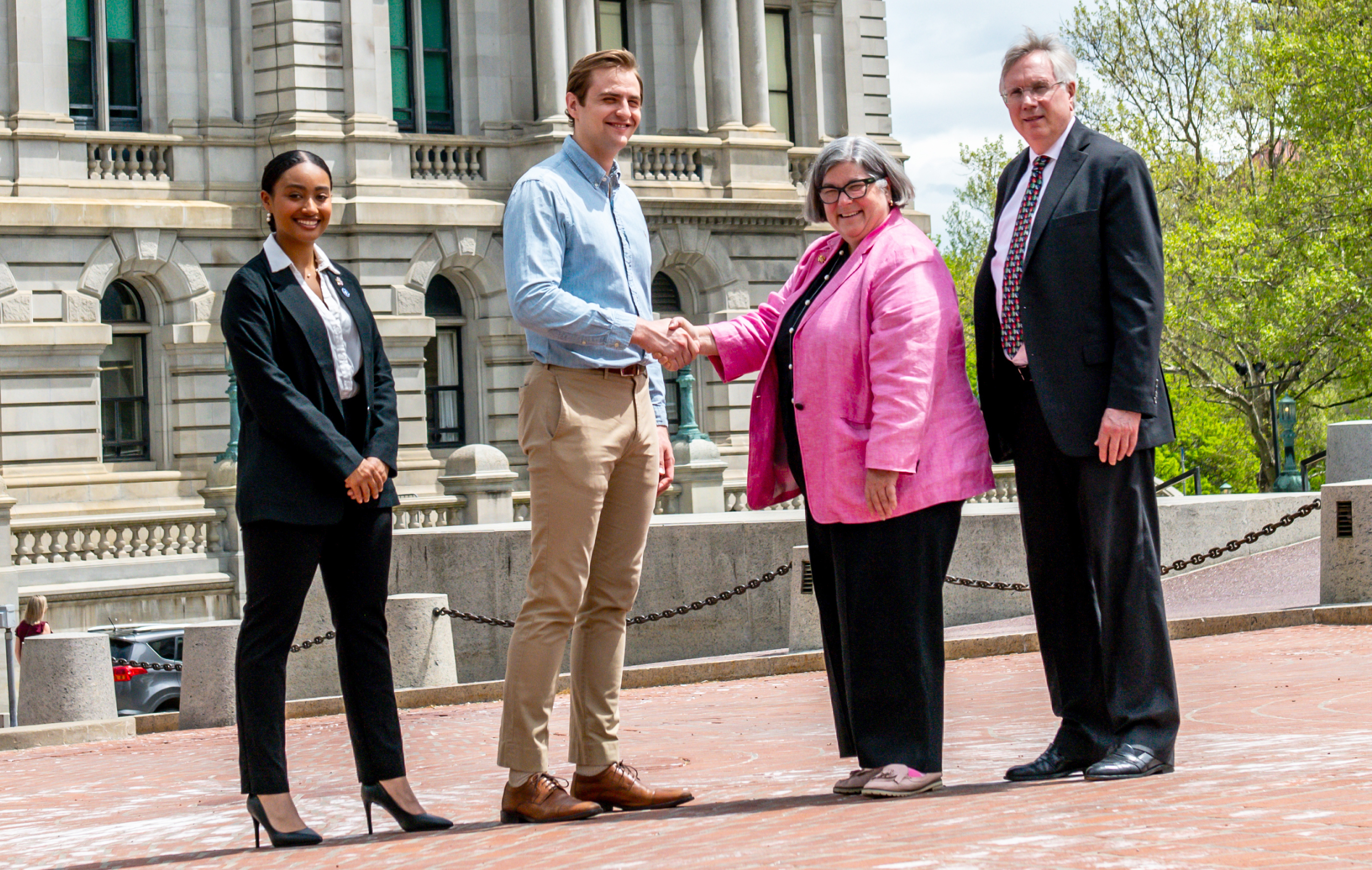
Anthony Monaco, DDS ’25, who joined Lloyd and second-year dental student Christina Chalmers on the Albany visit, was one of the inaugural recipients of the Dean’s Scholarship. For him, advocacy efforts are personal. He grew up in Laurens, New York, a town of about 2,400 people in Otsego County, where dental services are limited, and specialty dental care often requires driving upward of two hours for care. It’s an inconvenience for some, and a non-starter for others, who may not have the money or time to make the trip. To help address the healthcare disparity, Monaco expects to return to central New York to provide care in or near his hometown after he completes his general practice residency at NewYork-Presbyterian Brooklyn Methodist Hospital.
“Having grown up in a rural community, I have witnessed firsthand the impact that limited access to care can have on individuals and families,” Monaco said. “Given that many New Yorkers lack a dental home, it is imperative that state leadership and its institutions take active steps to address unmet oral health needs. Drawing from our training and patient care experiences, our group offered well-informed perspectives to help guide policymakers in a direction that promotes equitable access to dental care.”
In addition to state politicians, the Stony Brook contingent met with NYSDA members, and partnered with them in conversations with legislators. These partnerships, said Lloyd, are vital in advancing initiatives that may eventually benefit the public and the profession.
“Learning from and partnering with organizations like NYSDA and the American Dental Association only help to amplify our voice in advocating for oral healthcare for positive change,” he said.
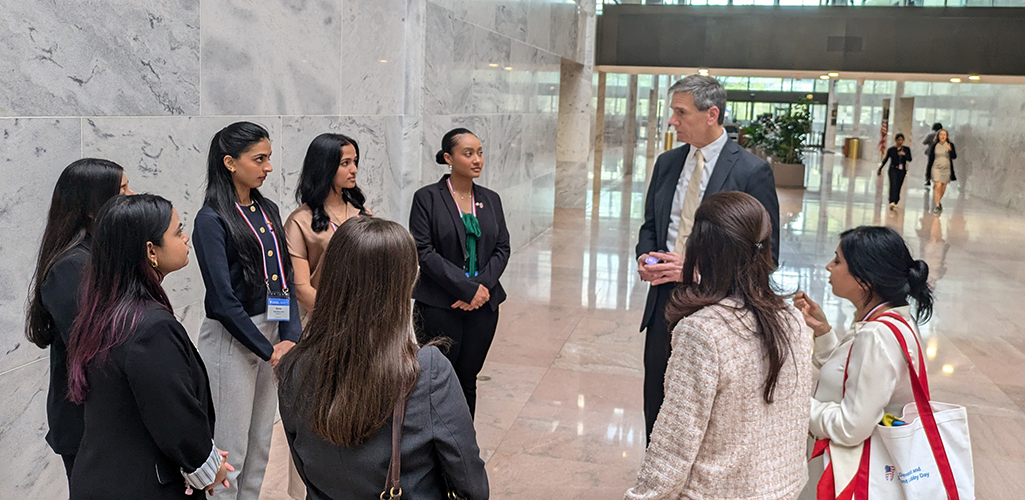
Advocacy, though, doesn’t stop at the state’s boundaries. To learn further about oral healthcare issues and policies at a national level, 10 Stony Brook dental students accompanied Lloyd to Washington, DC, for the ADA’s annual Dentist and Student Advocacy Day. Topics ranged from community water fluoridation and student loan reform to proposed bills such as the Dental and Optometric Care (DOC) Access Act, which is aimed at regulating anti-competitive practices by dental and vision insurance companies, restoring control to patients and providers. The Stony Brook collective met with New York legislators who convey their interests to a broader audience.
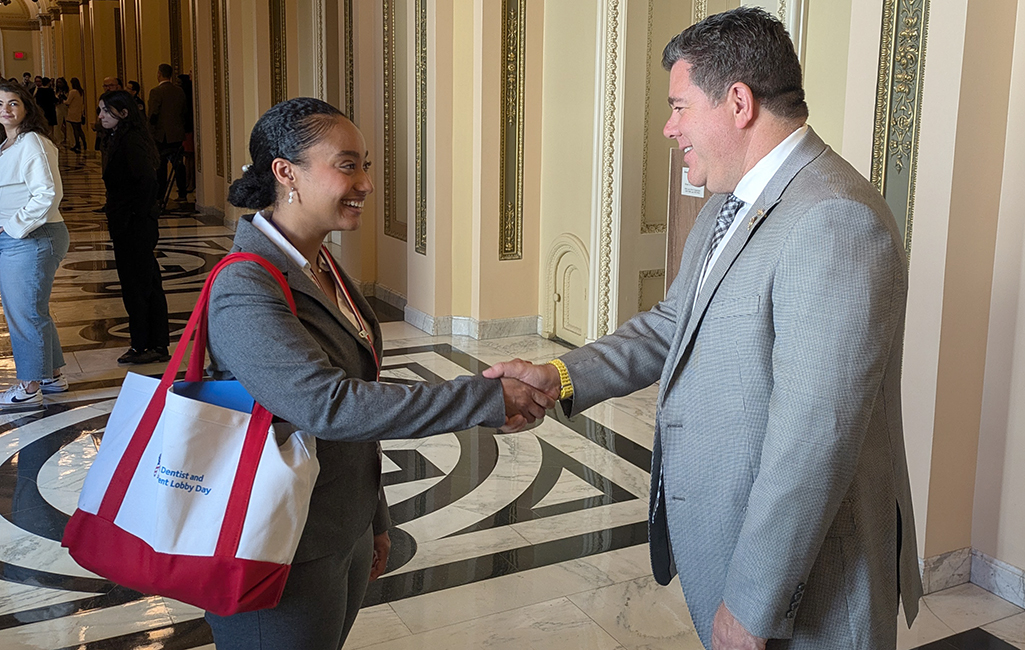
Chalmers connected with Congressman Nick LaLota inside the US Capitol building concerning topics including water fluoridation and the Resident Education Deferred Interest (REDI) Act, which has garnered bipartisan support from healthcare organizations, including the ADA. The bill would allow postgraduate students to earn interest-free deferment on their student loans during residency.
“It was an incredibly rewarding experience that showed how students can play a role in shaping the future of our profession and the quality of patient care,” Chalmers said. “Having the opportunity to speak with Representative LaLota offered a new perspective in support of the REDI Act — that of the dental student. Many of us have taken significant student loan debt to finance our education, and the REDI Act would offer us the opportunity to pause interest accrual, so we do not continue to accumulate debt while completing a specialty program. This would relieve a major financial burden and encourage more dentists to pursue careers in community health and research.”
The experience proved meaningful for her and her classmates — and by keeping these conversations going, the ripple effects could lead to lasting improvements in both patient care and the profession at large.