

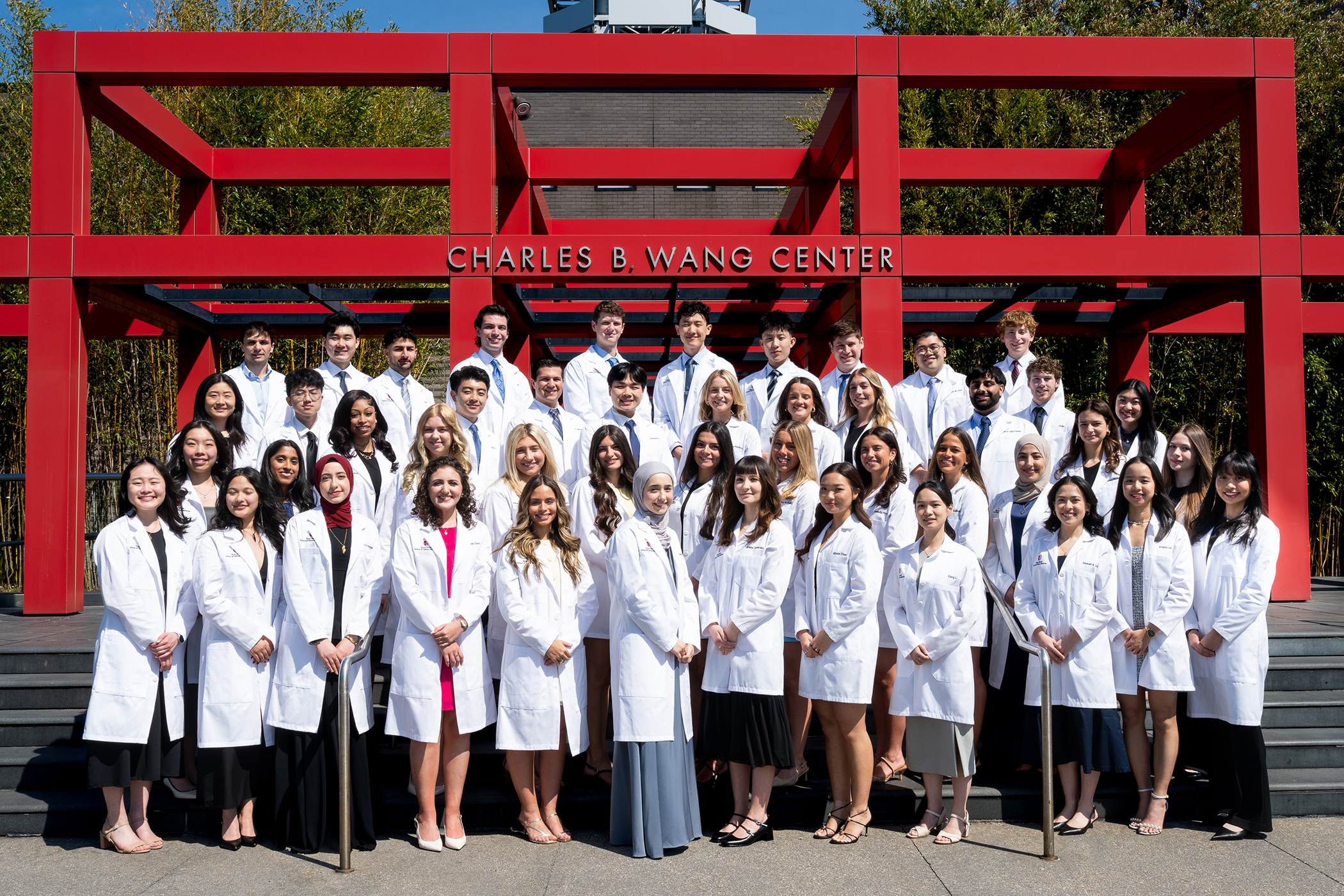
Symbolizing their commitment to the profession of dentistry and compassionate patient care, the School of Dental Medicine’s Class of 2029 officially received their white coats during the annual White Coat Ceremony on April 10 in Recital Hall at Stony Brook University’s Staller Center for the Arts.
Forty-six students crossed the stage before family and friends, faculty and staff, senior leadership from the Suffolk County Dental Society and industry partners. As is tradition at Stony Brook, students will begin treating patients in the Dental Care Center at the end of their first year before assuming a full patient schedule this fall. Stony Brook remains one of only a few dental schools in the country to provide patient care experiences during students’ first year.
“Today’s ceremony marks a milestone for the Class of 2029 as each of you transitions into the role of clinical care providers,” said Patrick Lloyd, DDS, MS, dean of the School of Dental Medicine. “With this white coat, you are accepting the critical responsibility to provide compassionate, respectful and empathetic care. The coat serves as a visible mantel of the assumption of responsibility for the care you will provide to others.
“I know I speak for the entire School of Dental Medicine community when I say congratulations,” he continued. “We look forward to supporting you in this meaningful passage in your journey toward becoming Doctors of Dental Surgery.”
The Class of 2029 came to Stony Brook with the highest grade point average (3.85) of all first-year classes at New York State’s five dental schools. Eighty-one percent of the students are from New York, and many intend to remain in the state to serve patients in urban, suburban and rural communities. Reflecting the school’s commitment to expanding access to oral healthcare statewide, five members of the entering class come from upstate counties in New York, areas that serve patients in full or partial Dental Health Professional Shortage Areas (DHPSAs).
Brian Howe, DMD, MS, associate dean for clinical operations and patient care, shared his advice with the first-year students, encouraging them to understand the importance of compassion, compromise and commitment to continuous improvement.
“During dental school, you will start to develop your library of skills,” Howe said. With each patient interaction you will add a word, paragraph, or page, to your book in your library. Over time, this library of knowledge will be vast but never complete. In order to amass this library of knowledge we must be committed to always learning, being humble about the things that may not have gone the way we wanted, and taking each opportunity to continuously improve.”
During the ceremony, the School of Dental Medicine Alumni Chapter presented the Distinguished Alumnus Award to Nadia Laniado, DDS '84, MPH, MS, director of community dentistry and population health at NYC Health + Hospitals/Jacobi Medical Center and North Central Bronx Hospital, and associate professor at the Albert Einstein College of Medicine, in recognition of her service to both her community and the profession. Laniado is also the program director of Jacobi’s Dental Public Health (DPH) Residency — the only residency of its kind in New York City — and the past president of the American Association of Public Health Dentistry (AAPHD).
“‘Open wide’” is a phrase you’ll be saying numerous times a day to your patients, but think of it also as an action step for yourself,” she said. “Open yourself wide to the world beyond your operatory, to the events and forces that are shaping your world, and to how, if you’re able to, react and respond to those forces. In orthodontics we talk about different kinds of forces — light and heavy, as well as continuous and intermittent. But this also applies to your life. Be patient with yourself, try to understand and acknowledge the forces that impact you, the forces that impact your patients, the forces that impact your community, and the forces that impact this wonderful profession, a profession you’re now a part of.”